Remote work feels simple. You complete a task, send an invoice, and expect to get paid.
But in reality, getting paid—especially across borders—is not a single step. It’s a process made up of multiple stages, each with its own timing and complexity.
Understanding this process helps explain why payments can take longer than expected.
It’s Not Just One Transaction
When people think about payments, they often imagine a direct transfer from company to worker.
In reality, the flow looks more like this:
- Work is completed
- An invoice is submitted
- The invoice is reviewed and approved
- Payment is processed internally
- Funds are transferred across systems
- Money arrives in your account
Each step may seem small, but together they form a system—not just a transaction.
Where Time Adds Up
Even in a smooth process, time adds up across steps.
- Invoice review can take a few days
- Approval may depend on internal workflows
- Payment processing often runs on fixed cycles
- International transfers may take additional time
In total, this can take anywhere from a few days to over a week.
And delays don’t usually come from one big issue—but from small pauses at each step.
What the Data Shows
This is where a simple visual helps.
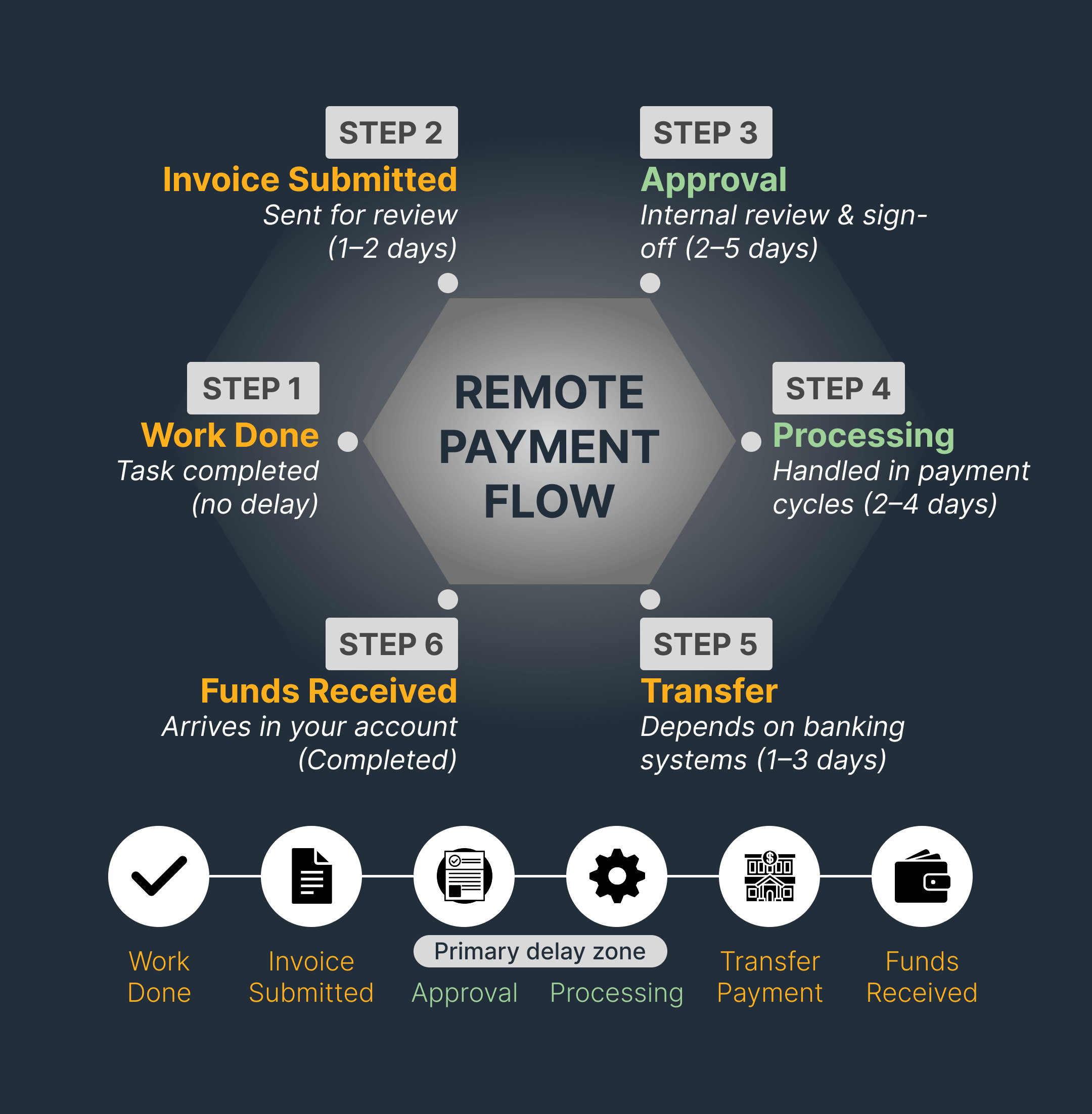
A typical remote payment flow involves multiple stages, with time distributed across each one.
Some steps move quickly, while others naturally take longer.
The process isn’t slow because it’s broken. It’s slow because it’s structured.
Why This Matters
For individuals, this explains why payments may not arrive as quickly as expected.
For companies, it highlights the importance of having a system that can handle these steps efficiently.
Because in global work, getting paid isn’t just about sending money.
It’s about managing a process that spans multiple layers.
A Final Thought
Remote work has made it easier to work from anywhere.
But behind that simplicity is a system that still needs to function across borders, processes, and rules.
And the better we understand that system, the easier it becomes to improve it.

Easy to start,
intuitive to use