
Vietnam’s education sector has become one of Southeast Asia’s most closely watched growth markets in recent years.
As the country’s middle class continues to expand, demand for English learning, international curricula, and private education services has increased significantly. In major cities such as Ho Chi Minh City and Hanoi, education-related businesses continue to grow alongside Vietnam’s broader international business environment.
For many overseas investors, Vietnam offers not only a young population and rising education demand, but also long-term potential within Southeast Asia’s evolving economy.
At the same time, education remains a relatively regulated industry. For foreign businesses entering Vietnam for the first time, understanding how the market operates in practice is often just as important as identifying the opportunity itself.
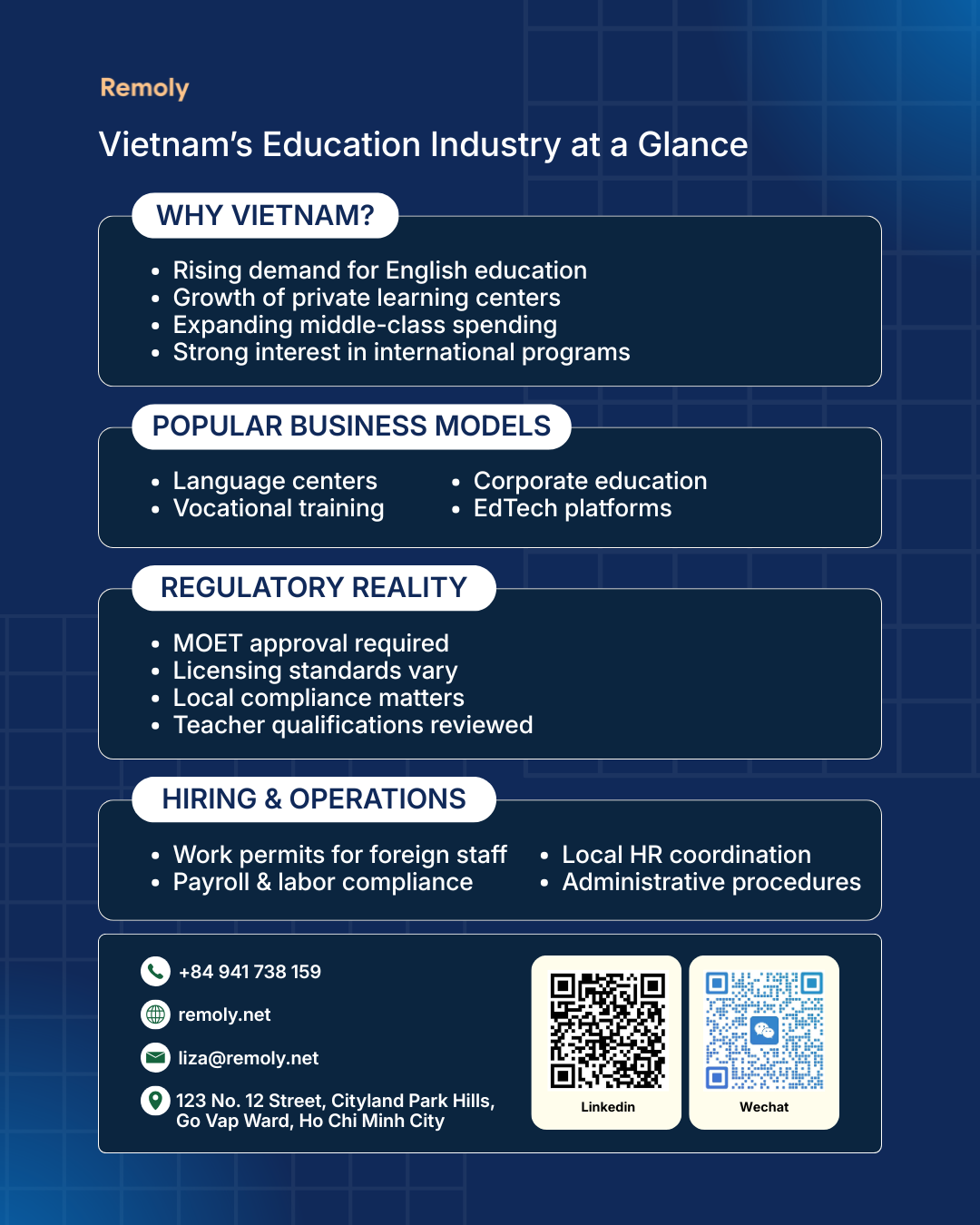
Entering the Market Often Involves More Than Many Investors Expect
Although foreign investors are allowed to establish education-related businesses in Vietnam, the setup process is not always as straightforward as company registration alone.
In practice, approval procedures, operational expectations, and administrative timelines may vary depending on the business model, province, and local authority interpretation. Because of this, businesses entering the market for the first time often underestimate how much local coordination is required during the early stages of setup.
For many foreign operators, the challenge is not necessarily market demand — but understanding how to navigate the local regulatory environment efficiently.
Operational Reality Can Look Different From Initial Expectations
One of the most common surprises for foreign education businesses is how operational processes work in practice.
Document legalization, teacher qualification reviews, licensing procedures, and local administrative coordination may sometimes take longer than initially expected. In some cases, requirements may also differ slightly between provinces or districts.
Because of this, timelines for launching operations are not always predictable, particularly for businesses without prior local experience.
Many foreign companies therefore choose to spend more time on preparation, internal planning, and local coordination before expanding into the market.
Hiring and Compliance Remain Important Long-Term Considerations
Beyond the initial setup phase, day-to-day operations also require ongoing attention.
For education businesses employing foreign staff, work permits, labor compliance, payroll administration, and visa procedures often become important operational considerations over time.
In practice, maintaining smooth operations usually depends on how well companies manage local administrative requirements and employment-related processes after the business has already been established.
As a result, many overseas businesses choose to work with local HR, compliance, or operational support teams to reduce administrative risk and improve operational efficiency.
Vietnam’s Education Sector Still Offers Strong Long-Term Potential
Despite the regulatory considerations involved, Vietnam’s education industry continues to offer significant long-term opportunities.
Demand for English education, vocational training, bilingual programs, and digital learning solutions is expected to continue growing over the coming years, particularly as international business activity across Vietnam continues to expand.
At the same time, rising household spending on education is helping drive continued growth across private and international education segments.
For many foreign investors, Vietnam remains one of Southeast Asia’s most promising education markets — especially for businesses prepared to approach expansion with long-term operational planning and a strong understanding of local market realities.
Practical Considerations for Foreign Businesses
For overseas education companies planning to enter Vietnam, preparation often plays a major role in determining how smoothly expansion progresses.
Understanding local regulations, operational procedures, and employment requirements early can help reduce delays, improve coordination, and support more stable long-term operations.
Rather than rushing into the market, many foreign businesses find that building a reliable local operational and compliance structure early on is often more beneficial for sustainable growth.

Easy to start,
intuitive to use