
Vietnam’s healthcare industry has become one of Southeast Asia’s fastest-growing sectors in recent years.
As the middle class continues to expand, demand for higher-quality healthcare services, private medical care, and international-standard treatment is increasing across the country. In major cities such as Ho Chi Minh City and Hanoi, private clinics, specialized healthcare services, and digital health businesses have seen particularly strong growth.
For many foreign businesses, Vietnam offers long-term market potential alongside rising demand for better healthcare services.
At the same time, healthcare remains one of the more tightly regulated industries in Vietnam. For companies entering the market for the first time, understanding how local operations work is often just as important as identifying business opportunities.
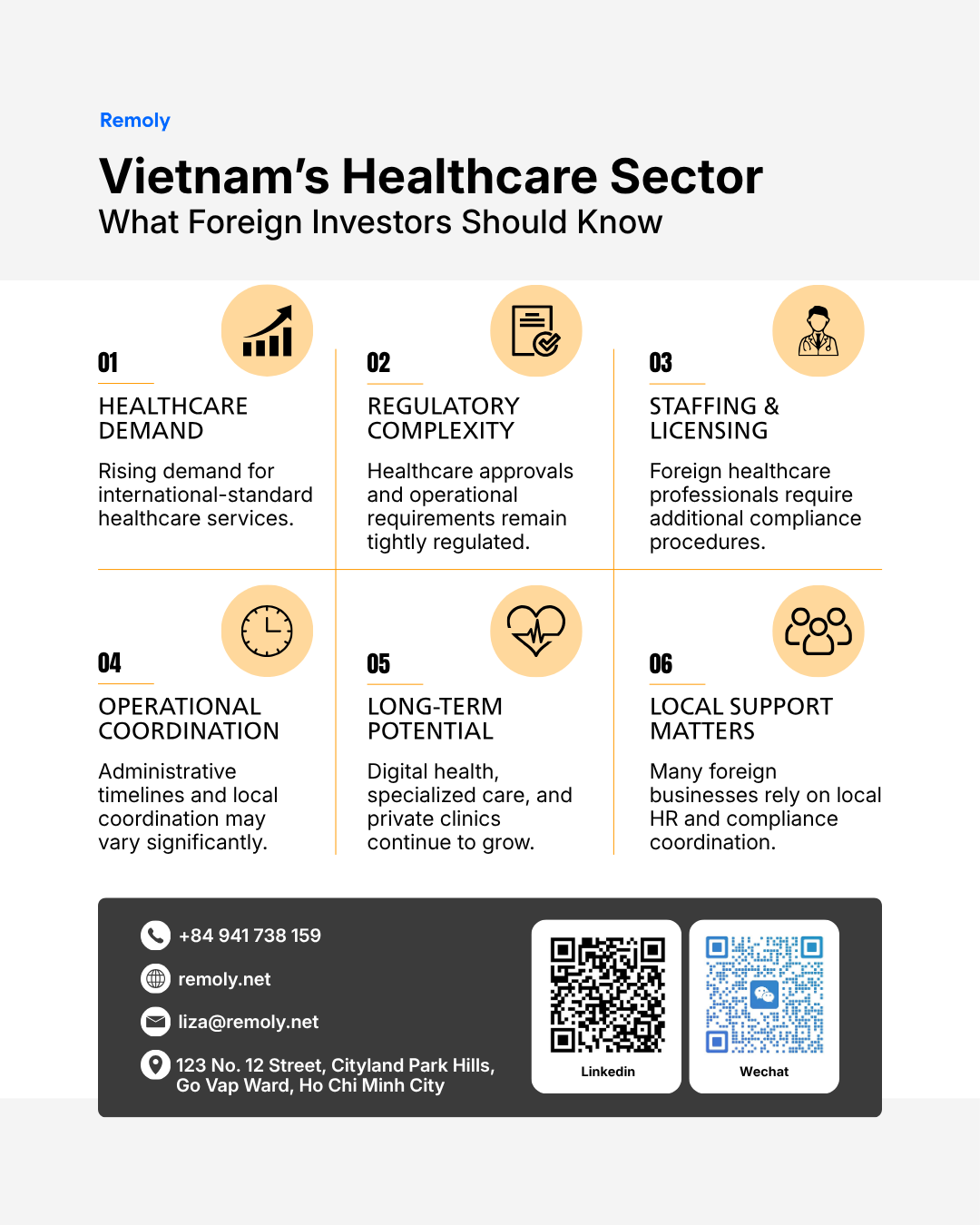
Entering Vietnam’s Healthcare Market Often Requires More Preparation Than Expected
Although foreign investors are allowed to operate certain healthcare-related businesses in Vietnam, entering the market is often more complex than company registration alone.
In practice, approval timelines and operational requirements may vary depending on:
- the business model,
- the type of healthcare service,
- the local authority,
- and the province where the business operates.
For this reason, many foreign businesses underestimate how much local coordination is needed during the setup stage.
For healthcare companies, the biggest challenge is often not market demand — but understanding how local administrative and operational processes work in practice.
Operational Timelines May Look Different in Reality
Many foreign healthcare businesses are surprised by how much time operational preparation can require.
In practice, delays often happen during:
- administrative approvals,
- document legalization,
- qualification reviews,
- and local coordination processes.
In some cases, operational standards and implementation requirements may also differ between provinces or local authorities.
For businesses without prior experience in Vietnam, expansion timelines may not always move as quickly as expected.
Because of this, many overseas companies now place greater focus on early planning and local operational support before entering the market.
Hiring and Compliance Quickly Become Long-Term Priorities
Beyond the setup stage, hiring and workforce management also become important parts of long-term operations.
For healthcare businesses employing foreign staff, ongoing requirements may include:
- work permits,
- labor compliance,
- visa procedures,
- payroll administration,
- and local employment regulations.
In practice, smooth business operations often depend on how effectively companies manage local administrative and workforce-related processes.
As a result, many foreign healthcare businesses choose to work with local HR, compliance, or operational support teams to improve efficiency and reduce administrative risk.
Vietnam’s Healthcare Industry Still Holds Strong Long-Term Potential
Despite regulatory challenges, Vietnam’s healthcare market continues to show strong long-term growth potential.
Over the coming years, sectors expected to continue growing include:
- private healthcare,
- specialized clinics,
- digital health,
- elderly care,
- and premium medical services.
At the same time, rising healthcare expectations and increasing household healthcare spending are continuing to drive demand for higher-quality medical services across Vietnam.
For foreign businesses prepared to approach the market with long-term planning and strong local coordination, Vietnam remains one of Southeast Asia’s most promising healthcare markets.
Practical Considerations for Foreign Businesses
For overseas healthcare businesses planning to expand into Vietnam, preparation often plays a major role in long-term success.
Understanding local regulations, hiring requirements, and operational processes early can help businesses reduce delays and improve coordination during expansion.
Rather than entering the market too quickly, many companies find that building a stable local operational and compliance structure early creates a stronger foundation for sustainable growth.

Easy to start,
intuitive to use