
Expanding into Vietnam has become an increasingly attractive option for many foreign businesses. From manufacturing and trading to technology and professional services, the country continues to position itself as one of Southeast Asia’s fastest-growing markets.
On paper, many operational processes may appear relatively straightforward. Company registration, banking procedures, administrative filings, and day-to-day business setup often follow clear formal requirements.
However, many businesses only begin to understand the operational reality of Vietnam after entering the market itself.
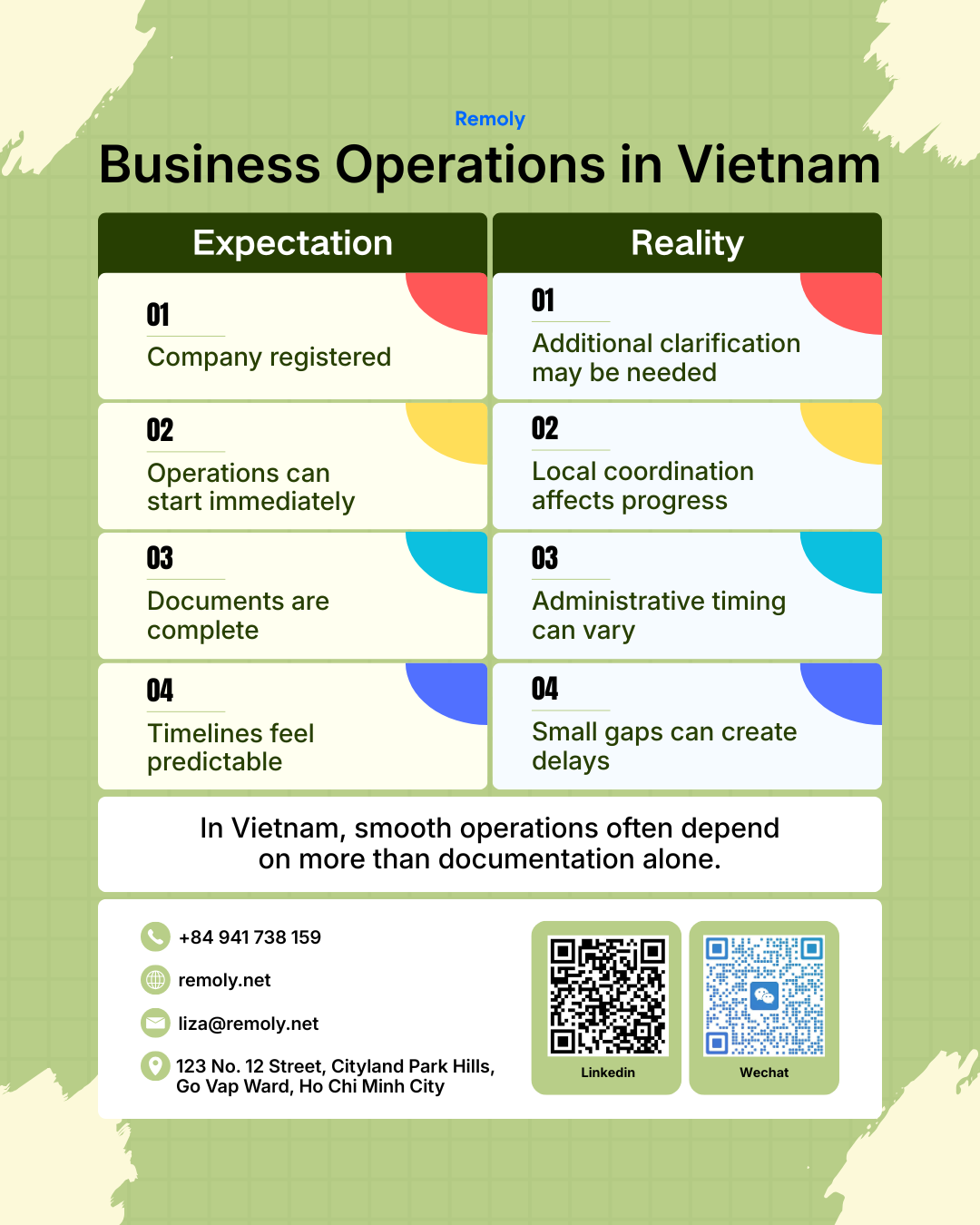
In practice, smooth business operations often depend on far more than documentation alone.
Operational Challenges Are Often Not “Major Problems”
For many foreign businesses entering Vietnam for the first time, the biggest operational difficulties are usually not caused by serious legal or regulatory violations.
Instead, delays and inefficiencies often come from smaller operational factors such as:
- local coordination,
- communication timing,
- administrative follow-up,
- document clarification,
- and differences in handling between institutions.
Individually, these issues may seem minor. But over time, they can significantly affect operational efficiency and business timelines.
This is one reason why many foreign companies initially underestimate how much operational rhythm matters in Vietnam.
Why More Businesses Are Prioritizing Local Operational Support
As competition in Vietnam continues to grow, many foreign businesses are shifting their priorities beyond registration and licensing alone.
More companies are beginning to focus on building stable local operational systems early, including:
- administrative coordination,
- HR and workforce management,
- banking communication,
- compliance support,
- and day-to-day operational follow-up.
For businesses planning long-term expansion in Vietnam, these operational foundations often become just as important as the initial market entry process itself.
Understanding Local Operational Rhythm
Vietnam’s business environment continues to offer strong long-term growth potential.
However, many companies eventually realize that successful operations in Vietnam are not only about understanding regulations or completing formal procedures.
In many cases, understanding how local operations actually move — including communication practices, coordination flow, and administrative rhythm — plays an equally important role in long-term operational stability.
For foreign businesses entering Vietnam, preparation increasingly means more than paperwork alone.
Final Thoughts
Vietnam remains one of Southeast Asia’s most promising markets for foreign investment and long-term business expansion.
But for many companies, operational success depends not only on entering the market, but also on adapting to how business operations function locally.
Many businesses eventually realize:
understanding how local operations actually work can be just as important as understanding the regulations themselves.

Easy to start,
intuitive to use