Many foreign investors assume there is only one way to describe a company that is not actively operating.
No revenue. No transactions. No business activity.
At first glance, situations like these can appear similar.
But in practice, discussions around company status are often more nuanced than a simple “operating” or “not operating” distinction.
That is one reason terms such as zero tax filing and business suspension are frequently mentioned together.
Even though they may appear similar from the outside, they are not always used in the same context.
So where does the confusion come from?
Why These Two Terms Are Often Mixed Together
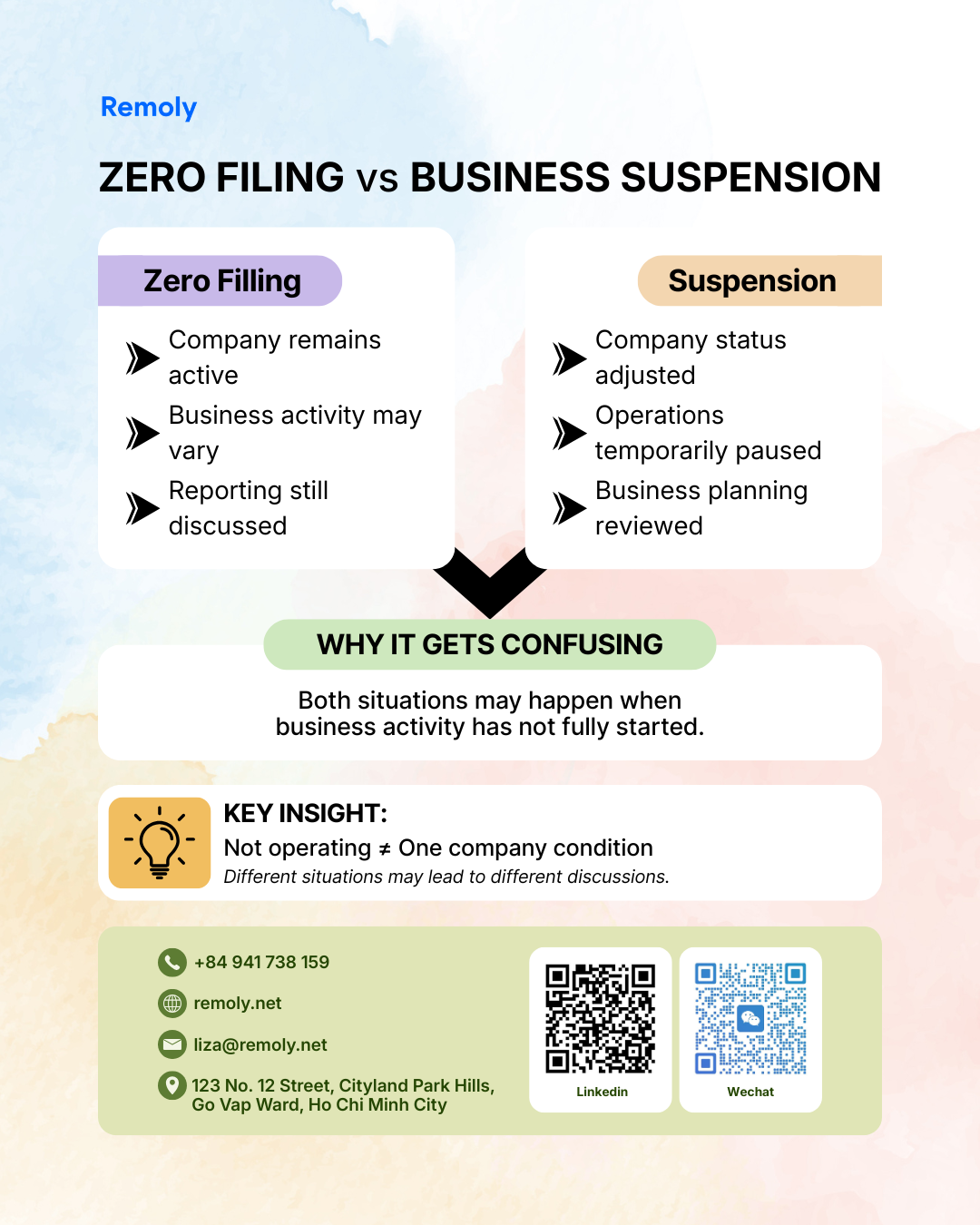
One reason is that both concepts often appear during periods when business activity has not fully started — or has temporarily slowed down.
From an outside perspective, the situation may look identical:
The company exists.
Operations appear limited.
Commercial activity may not yet be visible.
Because of that, many investors naturally assume the underlying discussion is also the same.
But in practice, similar business conditions do not always lead to identical interpretations.
That is why the same situation may sometimes lead to different operational or planning conversations.
Looking Beyond Labels
When entering a new market, there is often a tendency to search for the “correct category” as early as possible.
But in some situations, understanding the company’s current stage may provide more context than selecting a label immediately.
Questions such as:
- What stage is the business currently in?
- Has commercial activity already started?
- Is the current setup aligned with internal planning?
may sometimes create a broader view of the situation.
This perspective does not replace compliance review.
But it may support internal discussions during periods of transition.
Final Thoughts
Terms like zero tax filing and business suspension are often discussed together because they can appear during similar business moments.
But similar moments do not always mean the same context.
For many investors, understanding the business stage first may sometimes be a useful starting point before deciding how to frame the discussion.

Easy to start,
intuitive to use