
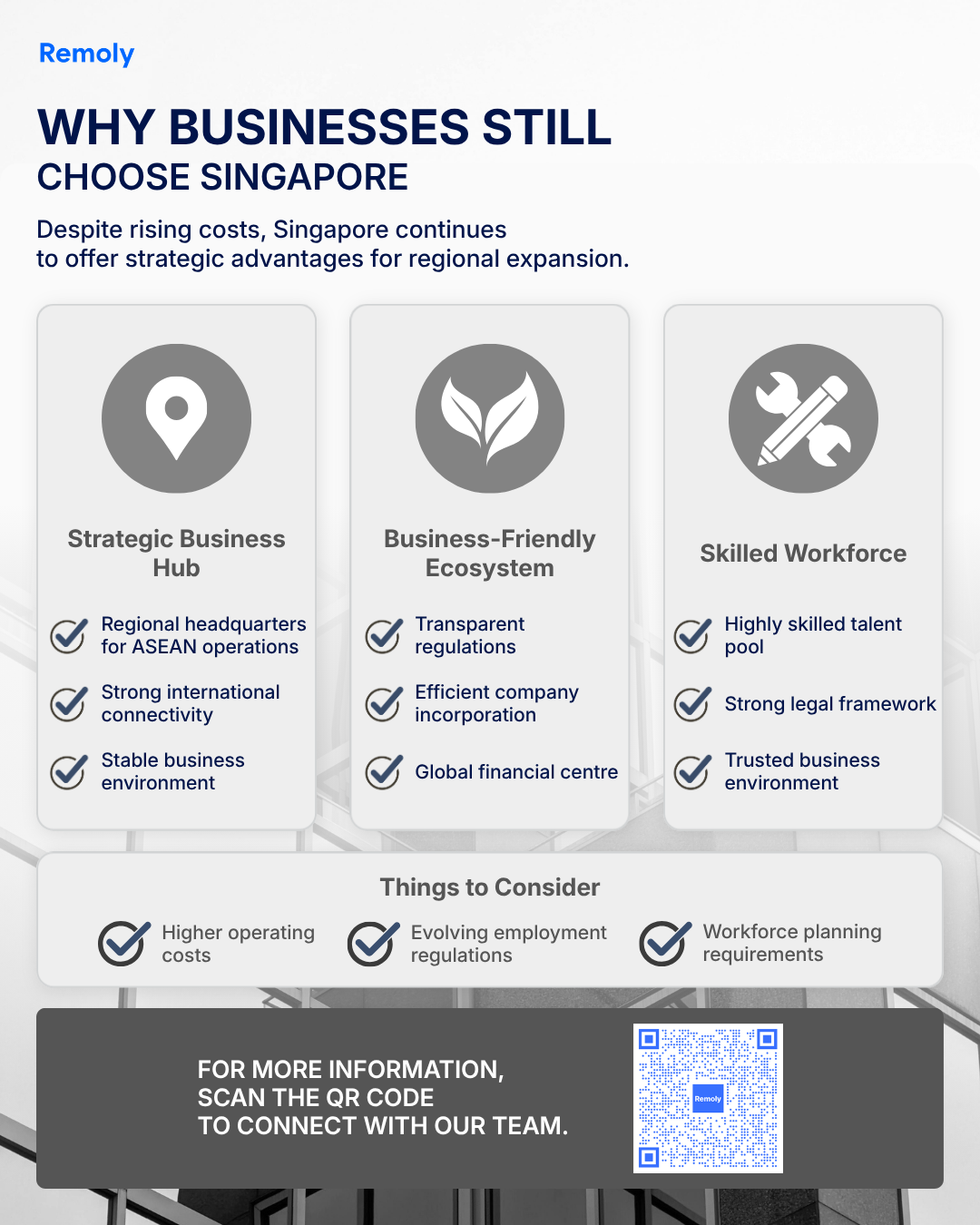
Singapore continues to attract multinational companies, startups, and international investors despite rising operating costs and evolving employment regulations. While the business environment has become more complex, the country's strategic position, regulatory transparency, and access to regional markets remain key reasons why companies choose Singapore as a base for expansion.
Rather than asking whether Singapore is still a good place to do business, companies should evaluate whether it aligns with their long-term business objectives.
For many businesses entering Asia, Singapore is often one of the first markets considered. Its reputation for political stability, transparent regulations, efficient corporate governance, and international connectivity has made it a preferred destination for regional headquarters and cross-border operations.
However, today's expansion decisions involve more than comparing tax rates or incorporation costs. Rising operating expenses, evolving workforce policies, and increasing competition across Southeast Asia mean businesses should take a broader view when evaluating their expansion strategy.
Singapore remains a strong option—but not necessarily for the same reasons it was a decade ago.
Looking Beyond Singapore's Advantages
Singapore's strengths are well known, but successful market entry depends on how those advantages align with a company's business priorities.
Instead of asking whether Singapore is "the best" destination, businesses should begin by asking what they expect Singapore to accomplish within their regional expansion strategy.
For some companies, Singapore serves as a regional headquarters that supports operations across Southeast Asia. Others use it as a base for sales, business development, or strategic partnerships. Companies with different operational models may find that neighbouring markets offer stronger advantages for manufacturing, labour-intensive operations, or cost optimisation.
Understanding the purpose of your expansion should come before deciding where to establish your business.
Four Questions Businesses Should Consider
1. What is the primary objective of your expansion?
Entering a new market can mean different things for different businesses. Whether your goal is regional management, customer acquisition, investment, or operational expansion will influence whether Singapore is the most suitable location.
2. How does Singapore fit into your regional strategy?
Singapore is often most effective as part of a broader Southeast Asia strategy rather than as a standalone market. Businesses should evaluate how Singapore complements other countries where production, hiring, or sales activities may take place.
3. Have you evaluated the total operating costs?
Business expansion involves more than company registration. Employers should consider workforce costs, statutory employment obligations, compliance requirements, office expenses, and ongoing administrative responsibilities when assessing long-term investment.
4. Are you planning for long-term growth?
Expansion decisions should support future business objectives, not only immediate market entry. Choosing the right location requires balancing business opportunities, operational efficiency, talent availability, and regulatory stability over time.
Key Takeaways
Singapore remains one of Asia's most established business destinations, but selecting the right expansion market depends on more than reputation alone.
A successful expansion strategy starts with understanding your business objectives, evaluating regional opportunities, and choosing a market that supports sustainable long-term growth.

Easy to start,
intuitive to use