Expanding into a new market often begins with building new business relationships. Whether the agreement involves a supplier, distributor, service provider, or local partner, contracts help establish a shared understanding between both parties.
When discussing a new partnership, conversations often focus on pricing, timelines, and commercial terms. Those are certainly important, but in cross-border business, there are usually a few additional details worth considering before an agreement is signed.
While every transaction is different, the following points are commonly discussed during the contracting process in Vietnam.
Understanding who is signing the agreement
One of the first things businesses typically do is confirm the identity of the contracting parties.
This usually includes verifying the legal entity name and ensuring that the agreement reflects the correct business information. In many cases, companies also confirm that the individual signing the contract is acting on behalf of the organization.
Although this may seem like a small administrative step, it often helps create greater clarity from the beginning of a business relationship.
Language can help avoid misunderstandings
Cross-border contracts are commonly prepared in more than one language, particularly when the parties are based in different countries.
Many businesses choose bilingual agreements so that both sides can review the same commercial terms more comfortably. It's also common for contracts to specify how differences in interpretation would be handled if more than one language version exists.
The approach may vary depending on the agreement and the parties involved.
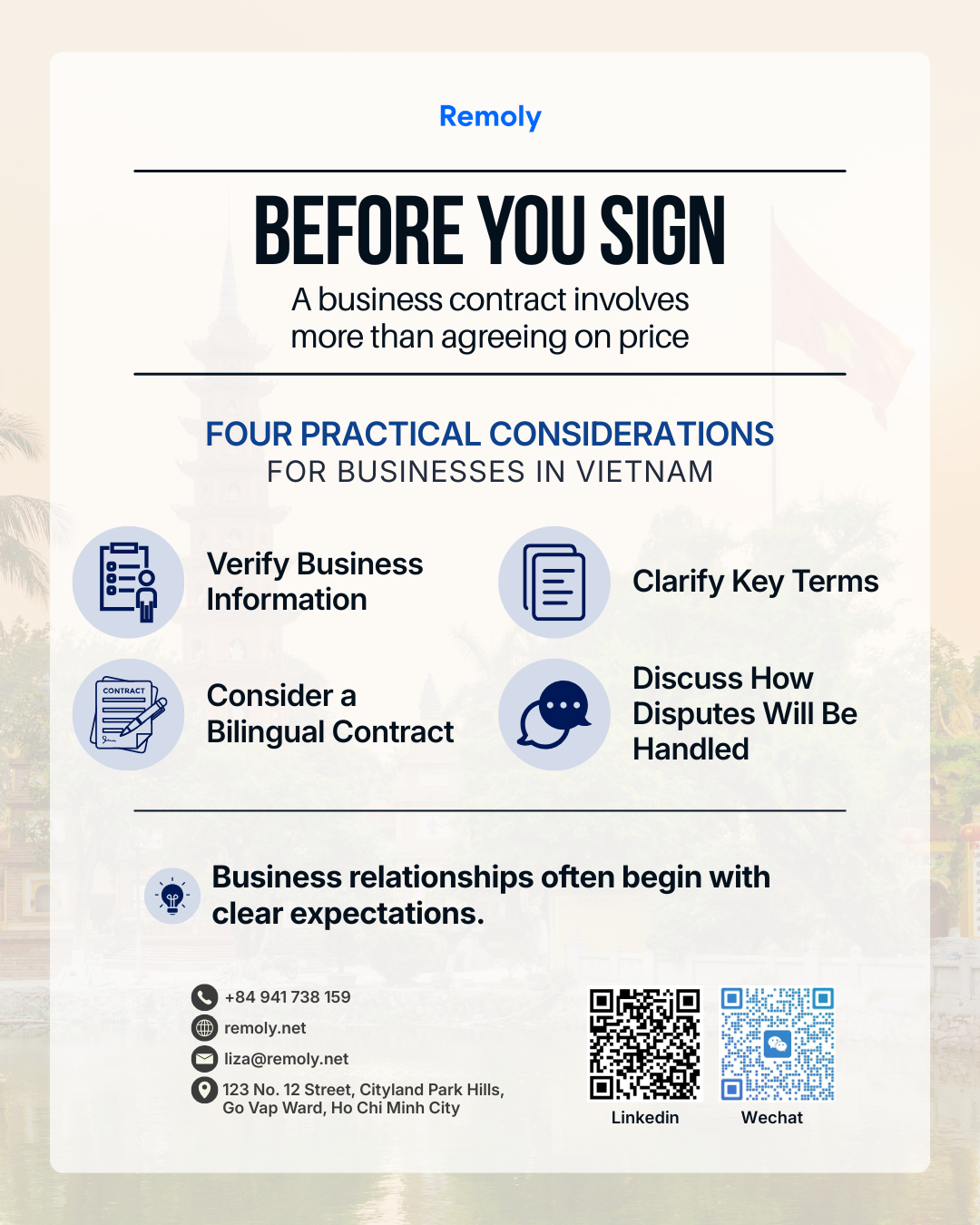
Planning for unexpected situations
No business partnership begins with the expectation of a dispute. Even so, many commercial agreements include provisions describing how potential disagreements would be managed if they arise.
Depending on the nature of the transaction, this may involve identifying the governing law or outlining a preferred dispute resolution mechanism.
Having these conversations early often provides greater certainty for both parties.
Clear expectations support smoother collaboration
Business agreements generally work best when important commercial terms are clearly described.
Depending on the type of project, this may include deliverables, timelines, responsibilities, quality expectations, or other operational details.
Clear documentation does not eliminate every challenge, but it can help both parties work from the same understanding throughout the collaboration.
Final Thoughts
Every business partnership is unique, and contract terms naturally vary depending on the transaction.
Taking time to discuss practical details before signing an agreement can help establish clearer expectations and support smoother collaboration as business relationships develop.

Easy to start,
intuitive to use